Experienced photographers select an aperture to achieve a specific depth-of-field, to either isolate the main subject against a blurred background, or achieve sharpness over the whole picture. The depth-of-field is the photographer’s intention, the aperture is just the tool.
And they select a shutter speed to either freeze or blur movements in the picture, and to avoid blur due to camera shake. Again, the motion freeze/blur is the photographer’s intention, the shutter speed is just the tool.
Finally, aperture and shutter speed define how much of the incoming light will fall on the sensor, so they need to align with the available light and the sensor sensitivity (ISO).
Modern digital cameras already “know” a lot about the shooting situation: The focal length, the camera shake, the capabilities of their Image Stabilizer, the exposure value, the subject distance. And they offer quite a range for the sensor sensitivity, offering a variety of “correct” aperture/shutter combinations.
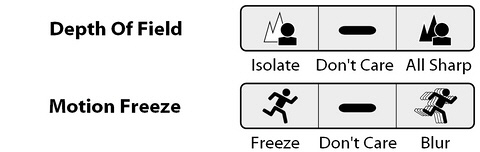
EZ[PiC]'s new camera user interface allows the photographer to tell the camera his Photographic Intention. That’s only two input parameters, depth-of-field and motion freeze/blur. Then the camera will be able to work its magic for the best picture result. Much easier to understand than the secrets of aperture and shutter speed, isn’t it?
Now, that’s not really new, you will already find depth-of-field and motion freeze/blur setting options on several recently released cameras. The first major new feature with EZ[PiC]’s interface is that it is not a separate “simple mode” maybe even buried in a sub-menu, but that the Photographic Intention Control becomes the heart of the camera control, and that it (in opposite to scene modes) blends perfectly in with all other advanced controls.
The other new feature is that we made it even easier to use: How many different choices should one really need to make? We believe with only three choices per parameter we can cover the majority of shooting situations (advanced cameras will offer fine tuning means for those few cases you need them).
Two parameters, three choices each: The most basic implementation would be two 3-button controls:
But it gets even easier, with a touch of a single button on EZ[PiC]'s » Photographic Intention Controller.
» [Next Page]